
TorrentFreak Email Update |

| Leaked: IFPI Tutorial On How To Stop Pre-Release Music Leaks Posted: 29 Jul 2012 03:33 AM PDT This week TorrentFreak has been running articles based on the leak of several IFPI and RIAA internal documents. Today’s article covers IFPI’s attempts to educate their members on how to mitigate a relatively new technique for obtaining pre-release music. Online release groups and other leakers have always been resourceful when it comes to getting the latest tunes, whether from light-fingered employees at CD packing plants or friendly music-reviewing sources with access to fresh promos. “Web piracy is similar to organized crime, there is a hierarchy, our goal is to identify those at the top,” Mo Ali, Head of Internet Anti-Piracy Operations at IFPI explained during his April 2012 presentation. IFPI’s investigative aims are to: 1. Identify the source site of the leak Ali adds that through their investigations, IFPI have been able to reduce the number of leaks. One such investigation, against the music release group “DOH”, is detailed in the slide below.  Another slide details how a South American blogger called “ALEKO” had been spotted posting pre-release music online. IFPI say that through various online profiles he was identified as a music journalist. IFPI sent a local investigator to speak to ALEKO and he confessed that he had tried to get music by blackmailing producers. Initially though, ALEKO said he’d been obtaining music from hackers. The hacking phenomenon is detailed by IFPI in the remaining slides. The music group reports that producers very often send tracks via email, so hackers try to gain access to their accounts in order to get music, even before it gets into promo form. In order to protect their members from such attacks (and this is good advice for anyone operating an email account), IFPI warns against phishing emails which claim to be from well-known file-storage sites but are really there to obtain email log-in details.  IFPI suggests a number of techniques for identifying bogus emails but then goes a step further by giving instructions on how to set up honey-traps to capture would-be music hackers.  IFPI say this method has already ensnared a number of individuals. Interestingly, one slide appears to shine light on a big pre-release raid earlier this year. The screenshot in the presentation slide below shows the RnBXclusive release blog site after it had been raided by the UK’s Serious Organized Crime Agency.  At the time, no-one could understand why the organized crime division of the police would be interested in a lowly music blog. But the inclusion of the site’s seized homepage in this report and the message that “The majority of music files that were available via this site were stolen from the artists” seem to point in a particular direction, at least as far as IFPI are concerned. Finally, it seems appropriate that we should augment this anti-leaking advice from IFPI with some security guidance of our own. In order to prevent reports on global anti-piracy strategy, offline vs online swapping, and another on the ineffectiveness of SOPA leaking out in public, please ensure that your Intranet doesn’t have a public-facing Internet webpage, even if it is only for a few minutes. 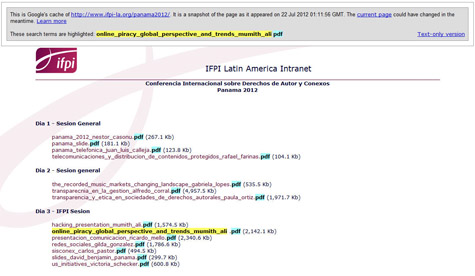 Source: Leaked: IFPI Tutorial On How To Stop Pre-Release Music Leaks |
| Music Labels Won’t Share Pirate Bay Loot With Artists Posted: 28 Jul 2012 06:20 AM PDT
This meant that the previously determined sentences handed out to Peter Sunde, Fredrik Neij, Gottfrid Svartholm and Carl Lundström will stand. Part of the sentence are damages that have to be paid to various entertainment industry companies. EMI Music, Universal Music, Sony Music and other labels, for example, were awarded around €550,000 to compensate artists and rightsholders for the losses they suffered. During the trial the court carefully weighed all the individual albums that were brought in as evidence. The resulting damages were eventually based on the fees The Pirate Bay would have paid if they had bought licenses for that content. The music labels were satisfied with this outcome, but have since had trouble collecting the damages. TorrentFreak got a peek at an unpublished document from the legal department of anti-piracy outfit IFPI, which documents the issue in more detail. “We have filed applications with Sweden's Enforcement Agency to secure assets to satisfy these funds. So far very little has been recovered as the individuals have no traceable assets in Sweden and the Enforcement Agency has no powers to investigate outside Sweden. There seems little realistic prospect of recovering funds,” the document reads. While it may come as no surprise that the music industry has a hard time getting money from The Pirate Bay defendants, what comes next may raise a few eyebrows. “There is an agreement that any recovered funds will be paid to IFPI Sweden and IFPI London for use in future anti-piracy activities,” IFPI writes. In other words, the money that the Court awarded to compensate artists and rightsholders for their losses is not going to the artists at all. Instead, the labels will simply hand it over to IFPI for their ongoing anti-piracy efforts, which we documented in detail earlier this week. According to former Pirate Bay spokesman Peter Sunde, one of the people convicted in the case, this shows who the real “thieves” are. “Regarding the issue that they’ve already divvied up the loot, it’s always fun to see that they call it ‘recovered money’ (i.e. money they’ve lost) but that they’re not going to give the artists in question any of it,” Sunde told TorrentFreak. “They say that people who download give money to thieves – but if someone actually ends up paying (in this case: three individuals) then it’s been paid for. So who’s the thief when they don’t give the money to the artists?” According to Sunde the news doesn’t come as a surprise. “As far as I know, no money ever won in a lawsuit by IFPI or the RIAA has even gone to any actual artist,” Sunde says. “It’s more likely the money will be spent on cocaine than the artists that they’re ‘defending’.” This is not the first time that artists have been left out when damages have been awarded in a copyright infringement case. The RIAA previously told TorrentFreak that the 'damages' accrued from piracy-related lawsuits will not go to any of the artists, but towards funding more anti-piracy campaigns. "Any funds recouped are re-invested into our ongoing education and anti-piracy programs," we heard. Source: Music Labels Won’t Share Pirate Bay Loot With Artists |
 February this year, Sweden's Supreme Court announced its decision not to grant leave to appeal in the long-running criminal case against the founders of The Pirate Bay.
| You are subscribed to email updates from TorrentFreak To stop receiving these emails, you may unsubscribe now. | Email delivery powered by Google |
| Google Inc., 20 West Kinzie, Chicago IL USA 60610 | |

No comments:
Post a Comment