
TorrentFreak Email Update |

| Demonoid Faces Prolonged Downtime After DDoS Attack Posted: 27 Jul 2012 03:07 AM PDT
Over the years the site has had its fair share of downtime, sometimes disappearing for months on end. Yesterday, a million plus Demonoid users noticed that they could no longer access the site. Instead of the usual welcome screen users were confronted with a “server busy” message, suggesting that the BitTorrent tracker is facing technical difficulties. TorrentFreak got in touch with the tech admin of the site who informed us that they are in serious trouble. Demonoid was overloaded by a DDoS attack which hit the server hard, resulting in a series of problems that may take a while to address. “It started as a DDoS but then it caused a series of problems. These problems need to be fixed before the site can go back up, and it’s a complicated fix this time,” the Demonoid admin told TorrentFreak. Aside from the DDoS assault, Demonoid’s server may also have been compromised by another attack. “There might have been an attack from another angle, an exploit of sorts, but it’s hard to tell right now without a full check of everything,” the admin says. While Demonoid is determined to return to its full glory, it might take a while before the site is up and running again. After an exodus of staff earlier this year there is only one person available to work on server issues, so progress is slow. “Our human resources became limited in the last few months. All tech issues are handled just by me now and there is no one else to take the job,” the admin told us, adding that his time is also limited by real life issues that take priority. “I’ll fix the site as soon as possible, but it might be a while this time,” the admin says. In recent years Demonoid has been in the cross-hairs of several anti-piracy outfits. It was pressured to move out of Canada by the CRIA and most recently the MPAA and RIAA reported Demonoid as a “rogue site” to the U.S. Government. However, there is no indication that the current attacks at Demonoid are anti-piracy related. For the millions of Demonoid users there’s no other option than to wait, once again. 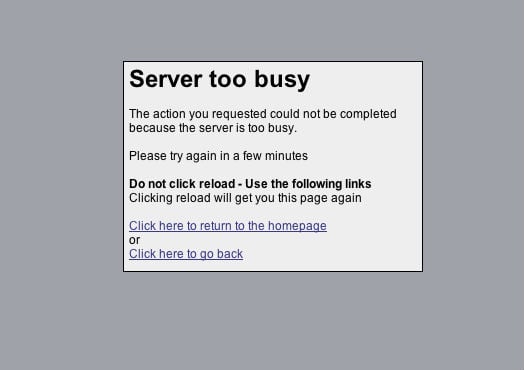 Source: Demonoid Faces Prolonged Downtime After DDoS Attack |
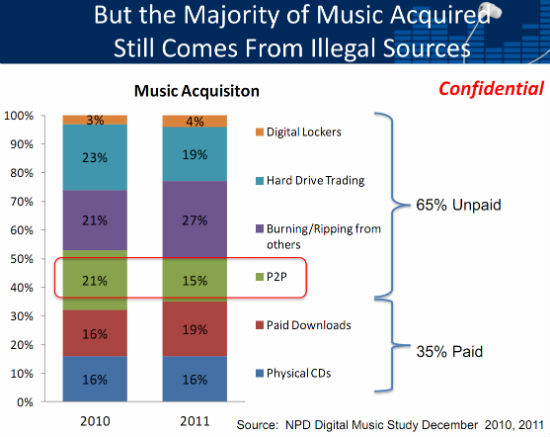
| RIAA: Online Music Piracy Pales In Comparison to Offline Swapping Posted: 26 Jul 2012 11:02 AM PDT In April, one of the RIAA’s key employees informed a group of music industry insiders about the upcoming six-strikes anti-piracy scheme in the U.S. TorrentFreak received a copy of the presentation sheets which include a rather interesting chart on where people get their music files from. The data presented by the RIAA comes from NPD’s Digital Music Study but has never been published in public in its current form. While NPD’s press release mentioned a decline in music acquisition through P2P file-sharing and hard drive trading, these numbers were not placed in a larger context. A strange decision, because the chart below is of critical importance for the debate on music piracy. As it turns out, two thirds of all music acquired in the U.S. is unpaid. However, offline trading is a much bigger source of unpaid music than online piracy. Of all “unpaid” music less than 30 percent comes from P2P file-sharing or cyberlockers. Music sources |

| You are subscribed to email updates from TorrentFreak To stop receiving these emails, you may unsubscribe now. | Email delivery powered by Google |
| Google Inc., 20 West Kinzie, Chicago IL USA 60610 | |

No comments:
Post a Comment